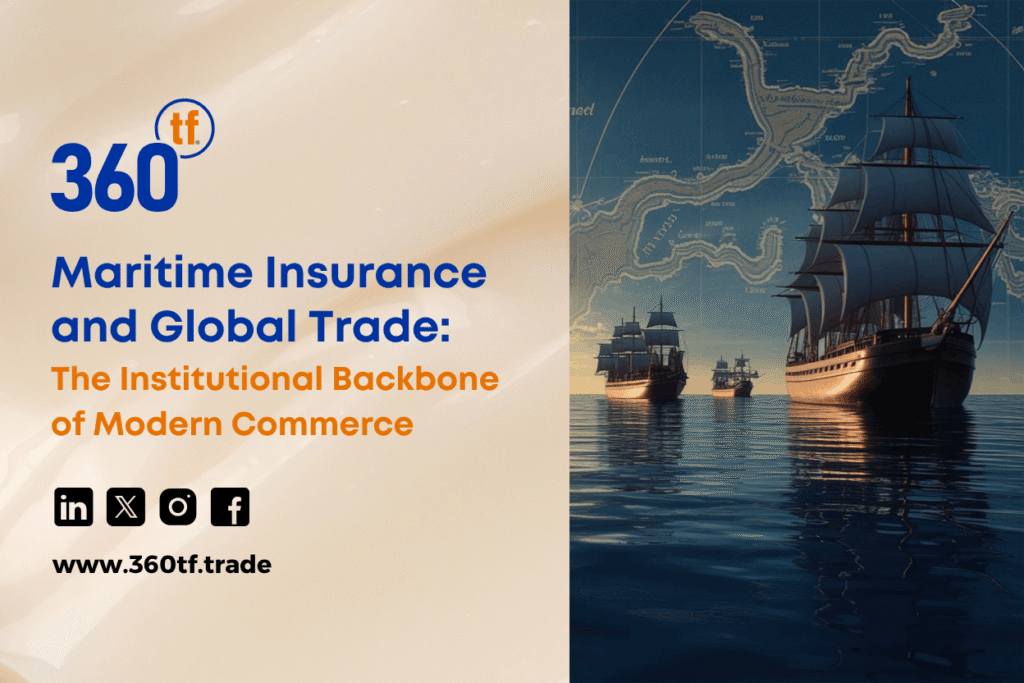
This article is the second part of a three-part series exploring the evolution of maritime insurance and its role in enabling global trade.
Maritime insurance marked a decisive shift in how global commerce was protected, financed, and sustained across oceans. What began as informal merchant risk-sharing gradually evolved into a structured system built on contracts, underwriting capital, and globally recognised standards.
The first article in this series explored the origins of maritime risk-sharing and early marine insurance.
The Evolution of Maritime Insurance with Global Trade
As international trade expanded across regions and oceans, maritime insurance evolved alongside it. Longer shipping routes, larger cargo values, and increasingly interconnected trade networks required more sophisticated methods of assessing and distributing risk.
What began as informal arrangements between merchants gradually developed into organised insurance systems supported by underwriting expertise, legal frameworks, and structured risk-sharing mechanisms. This transformation enabled maritime commerce to scale far beyond regional trade routes and laid the foundations for modern global trade.
Structured Underwriting: The Rise of Lloyd’s of London
One of the most significant developments in maritime insurance was the emergence of Lloyd’s of London.
From its origins in Edward Lloyd’s coffee house in late 17th-century London, Lloyd’s evolved into one of the world’s leading specialist insurance marketplaces. Merchants, shipowners, financiers, and underwriters gathered to exchange shipping intelligence and negotiate maritime risk.
Over time, this helped transform marine insurance from fragmented bilateral arrangements into an organised marketplace capable of supporting expanding global shipping and international commerce. Today, Lloyd’s remains one of the most recognised institutions in specialist insurance and continues to play a major role in global maritime risk markets.
Standardisation and the Institute Cargo Clauses
As global trade expanded across jurisdictions, inconsistent policy wording and differing interpretations of insurance coverage increasingly created operational and legal challenges.
To address this, the London insurance market introduced the Institute Cargo Clauses (ICC) in 1982 through collaboration between the Institute of London Underwriters and the Lloyd’s Underwriters Association.
The Institute Cargo Clauses helped:
- Standardise cargo insurance structures
- Reduce disputes arising from ambiguous policy interpretation
- Create a globally recognised framework for cargo protection
- Support international trade documentation and trade finance processes
The ICC framework remains one of the most widely used standards in global marine cargo insurance today.
The Containerisation Revolution and Trade Expansion
The containerisation revolution of the 1960s and 1970s fundamentally reshaped international trade. Standardised shipping containers improved efficiency, reduced cargo handling costs, accelerated port operations, and enabled the rise of large-scale global supply chains.
As trade volumes expanded, the importance of maritime insurance grew alongside it. Larger cargo exposures, increasingly globalised manufacturing networks, and more interconnected shipping systems required broader insurance coverage and more advanced underwriting capabilities.
Recent industry trends continue to reflect this growth. For instance, global shipping capacity is experiencing one of its strongest periods of expansion since the financial crisis of 2008.
Why Maritime Insurance Matters More Than Ever?
Maritime insurance remains one of the foundational pillars supporting international trade. Ships today carry over 80% of global merchandise trade by volume, making maritime transport central to the functioning of the global economy.
According to UNCTAD’s Review of Maritime Transport 2025, global seaborne trade reached approximately 12.7 billion tons in 2024, reflecting continued growth in international trade flows.
At the same time, the operating environment surrounding global shipping has become increasingly complex:
- Geopolitical tensions continue to disrupt traditional trade routes
- Vessel rerouting is increasing voyage times and operating costs
- Insurance premiums have risen sharply in higher-risk regions
- Supply chain disruptions are contributing to freight and pricing volatility
Recent disruptions across key Middle Eastern shipping corridors, particularly around the Red Sea and Suez Canal region, have demonstrated how quickly geopolitical developments can reshape global maritime logistics. Consequently, many vessels have rerouted around the Cape of Good Hope to avoid elevated security risks. This detour has significantly increased transit times, fuel consumption, freight rates, and overall insurance exposure.
These developments highlight that modern maritime insurance is not merely a protection mechanism for ships and cargo. Instead, it serves as a critical stabilising component of the global trade ecosystem itself.
What Maritime Insurance Covers
Modern maritime insurance generally operates across three interconnected areas of protection:
Hull Insurance
Hull insurance protects shipowners against physical damage to vessels arising from collisions, accidents, storms, or total loss events.
Cargo Insurance
Cargo insurance protects goods transported across international supply chains against transit risks. Consequently, it shields shipments from threats such as theft, damage, contamination, weather events, or loss. Insurance certificates are frequently required under trade finance structures such as letters of credit.
Protection and Indemnity (P&I) Cover
Protection and Indemnity (P&I) Clubs provide liability coverage for maritime operations. Specifically, this covers crew injury claims, environmental liabilities, wreck removal obligations, and third-party cargo claims.
360tf Insight: Insurance as an Enabler of Liquidity
Maritime insurance does more than protect cargo and vessels. It also supports liquidity across global trade ecosystems.
In many international trade transactions, the movement of capital depends heavily on the ability to assess, transfer, and insure risk. Marine insurance therefore supports trade finance structures, cross-border lending confidence, and supply chain continuity.
The Invisible Infrastructure Behind Global Commerce
Maritime insurance and global trade remain deeply interconnected. From early merchant voyages to modern global shipping networks, the ability to assess, distribute, and absorb risk has remained fundamental to international commerce.
Today, underwriting markets, global insurance syndicates, risk modelling systems, and international legal frameworks collectively support the uninterrupted movement of goods across oceans. Alongside this ecosystem, digital trade platforms like 360tf are helping accelerate trade execution and enable scalable, technology-driven working capital solutions across borders.
Global trade continues to evolve amid geopolitical fragmentation, supply chain disruption, and shifting trade corridors. Consequently, maritime insurance will remain central to maintaining confidence, resilience, and continuity across the global economy.
Series Note
The concluding article in this series will explore how geopolitical tensions, supply chain disruptions, climate-related risks, cyber threats, and evolving trade corridors are reshaping maritime insurance and influencing global trade flows.
Sources
UNCTAD – Review of Maritime Transport 2025
UNCTAD Review of Maritime Transport 2025
Lloyd’s – History of Lloyd’s
Lloyd’s History
International Maritime Organization (IMO)
International Maritime Organization